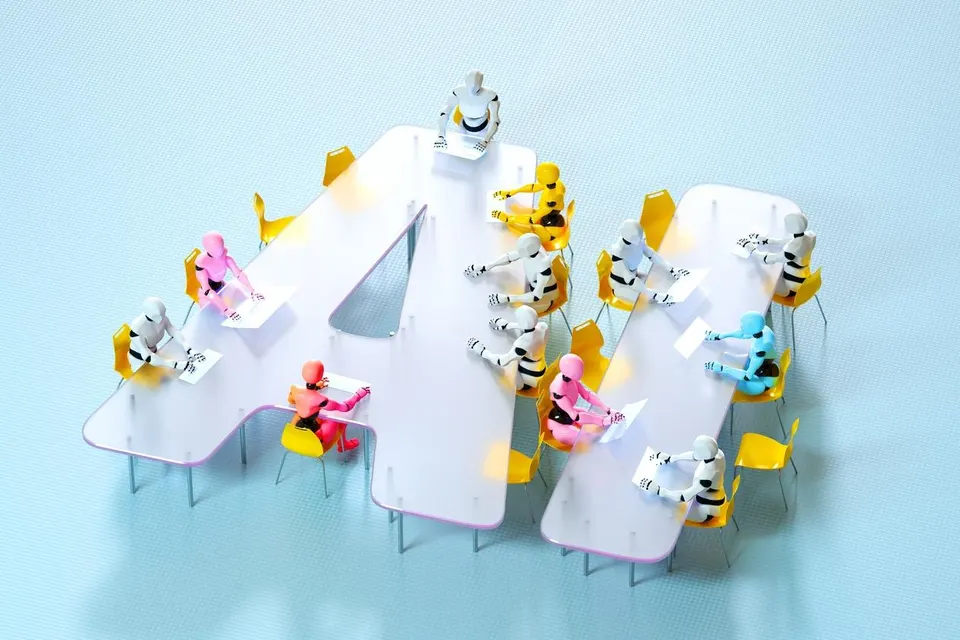
We see it all the time. Some aspect of AI gets a scary-sounding news cycle, and some AI evangelist or tech CEO attempts to reassure the room with a comparison to the industrial revolution, railroads, factories, elevators, typewriters. It’s meant to be comforting, to temper the unease. But it’s also wrong. Those technologies were engineered. Humans designed the parts, understood the mechanisms, and could predict how the system would behave before it left the factory floor. The difference is that modern AI, like a natural organism, is grown.
This isn’t just my personal take: Anthropic’s own Dario Amodei has said “generative AI systems are grown more than built,” and that their internal mechanisms are emergent rather than directly designed. Like growing a plant, you set the high-level conditions for an AI system and shape its growth rather than handcraft the outcome.
The mental model we need to adopt should be that of an invasive species, not an invention. And the more we let that mental model be inaccurate, the more it takes us down the wrong path of how we govern, secure, and try to control AI right now.
The Comfort of a Bad Analogy
Equating AI to something like a factory can feel reassuring: factories have blueprints, specific outputs, and a ceiling on their capabilities. A factory doesn’t wake up one day and decide it’s a car instead. But AI can, and it does.
When people reach for these analogies to past innovations, it’s either ignorance of how AI works, or it’s willfully choosing the comfortable comparison over the accurate one. It’s easier to regulate a factory than an organism, and that’s why so many people are trying to convince you AI is like the former.
AI Is Grown, Not Built
When you build a factory, you know what every piece does down to the last bolt, and you can predict how the final product will behave before it even starts to function. AI doesn’t work that way. Engineers set up the training process and feed it enormous amounts of data, but nobody hand-writes the rules the system ends up using. You’re not assembling a machine; you’re cultivating a garden. You can control the soil, water, and sunlight, but Mother Nature works on a vast amount of variables we can’t possibly account for.
That’s why AI systems regularly do things nobody explicitly trained them to do. A model trained only to predict the next word in a sentence can end up solving math problems or reasoning through questions it never saw an example of. As Nobel Prize winner Geoffrey Hinton says, AI is not a computer program. As it learns, it “extracts structure from data.” The abilities it gains are not programmed: they’re evolving behaviors, and they showed up on their own once the system got big enough.
If the people building these systems are still discovering what they can do after they’re already out in the world, that’s not engineering in the traditional sense, it’s cultivation. And it’s a different beast to govern something when even its creators are still learning what it’s capable of.
Why the “Invasive Species” Comparison is the Right Model
The USDA defines an “invasive species” as a something that is both non-native to an ecosystem and whose introduction causes or is likely to cause economic, environmental or human harm. As an example, the federal government promoted and paid farmers to plant kudzu across the South in the 1930s and 40s specifically to stop soil erosion, and for a while, it worked.
But the kudzu didn’t stay where it was planted. It can grow up to a foot a day, climbs trees, power lines, and anything else in its path. It now covers millions of acres and costs tens of millions a year to control. The government didn’t set out to create an ecological problem. They solved the problem in front of them. But they didn’t account for what that solution would do once theory was put into practice.
This is not a one-time occurrence either: cane toads brought into Australia to control a pest and instead becoming an ecological crisis, rabbits introduced for hunting reshaping a continent’s ecosystem.
Each of those introductions was well-intentioned and solved a real, immediate problem. But that’s exactly the trap. AI is being deployed the same way: useful and solving real problems in the short term, while its secondary effects on the surrounding “habitat” (labor markets, information ecosystems, institutions) are still not fully known.
The Wrong Mental Model Isn’t Just Academic
This isn’t a philosophical distinction: it ties directly into action. AI governance frameworks and regulatory proposals are being built on the “human-created technology” model. That means static compliance checklists and single-use audits versus ongoing monitoring and adaptive management. A factory uses the former. An invasive species requires the latter.
Bias and fairness in AI systems isn’t a one-time certification, it’s an ongoing monitoring discipline, because the thing you certified yesterday may behave differently today. That is the “invasive species” logic applied directly to governance. And it’s why we at SolasAI are working to bring that monitoring discipline to the forefront of the conversation.
Our leaders don’t need another AI history lesson comparing it to the last technology wave. They need a new mental model, one built for something that grows and adapts rather than something that was designed and shipped.
We need to get this right so we can build governance that actually holds up, and we need to do it fast. Anyone still borrowing metaphors from the industrial revolution is building fences for the wrong kind of threat. And that puts us in a very bad spot for the future.